Solving Jane Street's Knight Moves 7
Jane Street’s July 2026 puzzle, “Pent-Up” Frustration 3 / Knight Moves 7, combines a pentomino tiling, a knight moving in three dimensions, and a score whose update rule depends on whether the knight moves up, down, or stays level.
This post gives the full reconstruction. Everything below is a spoiler.
Question
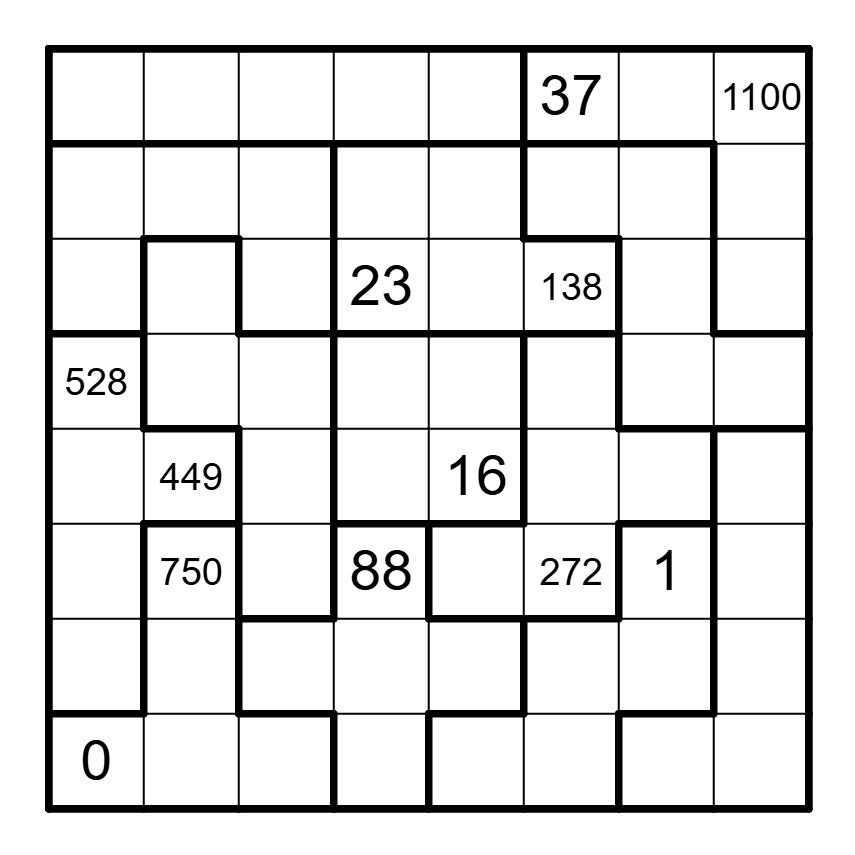
The board above has been tiled with the 12 pentominoes (plus a 2-by-2 tetromino) into 13 regions. Think of each of these 13 regions as constructed out of 1-by-1-by-1 cubes. We need to add a tower to each region. A tower is an additional size-1 cube placed on one of a region’s squares.
After adding these towers, place a knight at the bottom-left square. It then proceeds to make knight’s moves until it has visited all the towers. It never visits the same space twice. (A move on this board involves travelling 0 units in one dimension, 1 in another, and 2 in the third. The knight is allowed to “pass through” towers as it moves.)
But there’s a catch: As you can see, the knight starts with a score of 0. On its Nth move, its score increases by N if the move is to a location at the same altitude as the square it moved from. If, instead, it moves up, the score is multiplied by N. And finally, if it moves down, the score is divided by N. This last type of move is only allowed if the score is evenly divisible by N.
Every three moves, up until move #18, the knight wrote down its score upon arriving at a given square. From then on it only wrote down its score every K moves, for some larger value K. Using this information, can you reconstruct the knight’s path?
After filling all the remaining visited squares with the missing score values, find the unvisited squares. For each of these squares, compute the sum of the scores in any orthogonally adjacent squares that were part of the knight’s path. The answer to this puzzle is the sum of these “neighbor sums” from the unvisited squares.
1. Reading the board correctly
Each of the twelve pentominoes and the single 2-by-2 region receives one extra cube, or tower. It is useful to assign altitude 0 to an ordinary square and altitude 1 to the top of a tower.
The printed numbers are recorded scores. They are not tower heights or tower markers.
A legal three-dimensional knight move changes the absolute values of the three coordinates by 0, 1, and 2 in some order. That gives three cases:
| Move type | Altitude change | Displacement on the board | Score update on move n |
|---|---|---|---|
S | 0 | (1, 2) or (2, 1) | add n |
U | +1 | (0, 2) or (2, 0) | multiply by n |
D | −1 | (0, 2) or (2, 0) | divide by n, exactly |
Thus an ordinary chess-knight displacement is possible only between two locations at the same altitude. Moving between ground and a tower top instead looks like a two-square orthogonal move when projected onto the board.
The knight may pass over a tower. Only the starting and landing coordinates matter. For example, moving from ground-level e4 to a tower at e6 has displacement (0, 2, 1), so it is legal even if the jump’s projection crosses another occupied square.
2. The first three moves are forced
The knight starts at a1 with score 0, and the first printed checkpoint is the score 1 at g3 after move 3. The only valid operation pattern is
move 1: S,  0 + 1 = 1
move 2: S,  1 + 2 = 3
move 3: D,  3 ÷ 3 = 1
The geometry then forces
a1* → c2* → e3* → g3
where an asterisk marks a tower. The third move goes from e3 to g3 with displacement (2, 0, −1): e3 is a tower top and g3 is at ground level. Since the first two moves stay at the same altitude, a1 and c2 must also be tower tops.
3. Reconstructing the early checkpoints
Before move 18, the knight records its score every three moves. The arithmetic and geometry leave only one chronological order for those clues:
| Moves | Operations | Arrival | Score |
|---|---|---|---|
| 0 | — | a1 | 0 |
| 1–3 | SSD | g3 | 1 |
| 4–6 | SSS | e4 | 16 |
| 7–9 | UDS | d6 | 23 |
| 10–12 | SSU | a5 | 528 |
| 13–15 | SSD | f8 | 37 |
| 16–18 | SSS | d3 | 88 |
Written as score calculations:
0   --(+1, +2, ÷3)-->       1
1   --(+4, +5, +6)-->      16
16  --(×7, ÷8, +9)-->      23
23  --(+10, +11, ×12)-->  528
528 --(+13, +14, ÷15)-->   37
37  --(+16, +17, +18)-->   88
The large rises and falls are informative: they identify the upward and downward moves, which in turn constrain which squares can contain towers.
4. Why the later interval is K = 7
There are five printed checkpoints after move 18. A path on the 8-by-8 board can make at most 63 moves without revisiting a square, so
18 + 5K ≤ 63.
Because the problem says the new interval is larger than 3, only K = 4, 5, 6, 7, 8, 9 need to be checked.
For each candidate K, take the score 88 at move 18 and enumerate legal S, U, and D updates until the next possible printed checkpoint. A branch is rejected when:
- a division is not exact;
- the required planar displacement does not match its altitude change;
- a square would be revisited;
- a region would need zero or two towers; or
- the score and square disagree with the next printed checkpoint.
Only K = 7 survives. Its first seven-move block reaches f6 with score 138:
88
 +19 = 107
 +20 = 127
 ×21 = 2,667
 +22 = 2,689
 +23 = 2,712
 ÷24 = 113
 +25 = 138
Therefore the later checkpoints occur at moves 25, 32, 39, 46, and 53.
5. All remaining checkpoint arithmetic
The rest of the operation sequence is then forced:
| Moves | Operations | Arrival | Score |
|---|---|---|---|
| 19–25 | SSUSSDS | f6 | 138 |
| 26–32 | SSSSUDS | f3 | 272 |
| 33–39 | UDSSSSS | b4 | 449 |
| 40–46 | SSSSSSS | b3 | 750 |
| 47–53 | SSSSSSS | h8 | 1,100 |
| 54 | U | h6 | 59,400 |
The score calculations are:
 88 --(+19, +20, ×21, +22, +23, ÷24, +25)--> 138
138 --(+26, +27, +28, +29, ×30, ÷31, +32)--> 272
272 --(×33, ÷34, +35, +36, +37, +38, +39)--> 449
449 --(+40, +41, +42, +43, +44, +45, +46)--> 750
750 --(+47, +48, +49, +50, +51, +52, +53)--> 1,100
The value at f3 is now easy to interpret: it is reached on move 32 at ground level, so the score changes from 240 to 240 + 32 = 272. The tower in that F-shaped region remains at e3.
By move 53, the knight has visited twelve towers. The only legal completion is the upward move from ground-level h8 to the last tower at h6. On move 54,
1,100 × 54 = 59,400.
6. The unique route
Once every move has been classified as S, U, or D, a direct backtracking search is small. A state needs only the current square and score, the visited squares, and the chosen tower square in each region. At a printed checkpoint, all branches except the matching square and score can be discarded.
Applying those constraints gives the following unique 55-square route:
a1* → c2* → e3* → g3 → h1 → f2 → e4 → e6* → e8 → d6
→ c8 → a7 → a5* → b7* → d8* → f8 → d7 → c5 → d3 → b2
→ a4 → c4* → e5* → f7* → h7 → f6 → d5 → c3 → a2 → c1
→ e1* → g1 → f3 → h3* → h5 → g7 → f5 → e7 → c6 → b4
→ a6 → c7 → b5 → a3 → b1 → d2 → b3 → d4 → e2 → f4
→ g2 → h4 → g6 → h8 → h6*
Every consecutive pair has coordinate differences 0, 1, and 2 after altitude is included, and no board square appears twice.
7. The thirteen towers
The tower positions, listed in visitation order, are:
| Tower | Move | Square | Region shape | Arrival score |
|---|---|---|---|---|
| 1 | 0 | a1 | T | 0 |
| 2 | 1 | c2 | X | 1 |
| 3 | 2 | e3 | F | 3 |
| 4 | 7 | e6 | P | 112 |
| 5 | 12 | a5 | Y | 528 |
| 6 | 13 | b7 | U | 541 |
| 7 | 14 | d8 | I | 555 |
| 8 | 21 | c4 | N | 2,667 |
| 9 | 22 | e5 | 2-by-2 | 2,689 |
| 10 | 23 | f7 | Z | 2,712 |
| 11 | 30 | e1 | W | 7,440 |
| 12 | 33 | h3 | L | 8,976 |
| 13 | 54 | h6 | V | 59,400 |
There is exactly one tower in each of the twelve pentomino regions and one in the central 2-by-2 region.
8. The completed score grid
Filling each visited square with its score gives the following board. An asterisk marks a tower, and an em dash marks an unvisited square.
| Rank | a | b | c | d | e | f | g | h |
|---|---|---|---|---|---|---|---|---|
| 8 | — | — | 33 | 555* | 14 | 37 | — | 1,100 |
| 7 | 44 | 541* | 530 | 53 | 372 | 2,712* | 299 | 113 |
| 6 | 489 | — | 410 | 23 | 112* | 138 | 1,047 | 59,400* |
| 5 | 528* | 572 | 70 | 164 | 2,689* | 335 | — | 264 |
| 4 | 127 | 449 | 2,667* | 797 | 16 | 894 | — | 995 |
| 3 | 615 | 750 | 191 | 88 | 3* | 272 | 1 | 8,976* |
| 2 | 219 | 107 | 1* | 704 | 845 | 10 | 944 | — |
| 1 | 0* | 659 | 248 | — | 7,440* | — | 240 | 5 |
9. The nine unvisited squares
For each unvisited square, the puzzle asks for the sum of the scores in its orthogonally adjacent visited squares.
| Unvisited square | Adjacent path scores | Neighbor sum |
|---|---|---|
| a8 | 44 | 44 |
| b8 | 33 + 541 | 574 |
| g8 | 37 + 1,100 + 299 | 1,436 |
| b6 | 489 + 410 + 541 + 572 | 2,012 |
| g5 | 335 + 264 + 1,047 | 1,646 |
| g4 | 894 + 995 + 1 | 1,890 |
| h2 | 944 + 8,976 + 5 | 9,925 |
| d1 | 248 + 7,440 + 704 | 8,392 |
| f1 | 7,440 + 240 + 10 | 7,690 |
Finally,
44 + 574 + 1,436 + 2,012 + 1,646 + 1,890 + 9,925 + 8,392 + 7,690 = 33,609.
So the unique solution has checkpoint interval K = 7. The thirteenth and final tower is at h6, where the score becomes 59,400, and the answer requested by the puzzle is
33,609.